
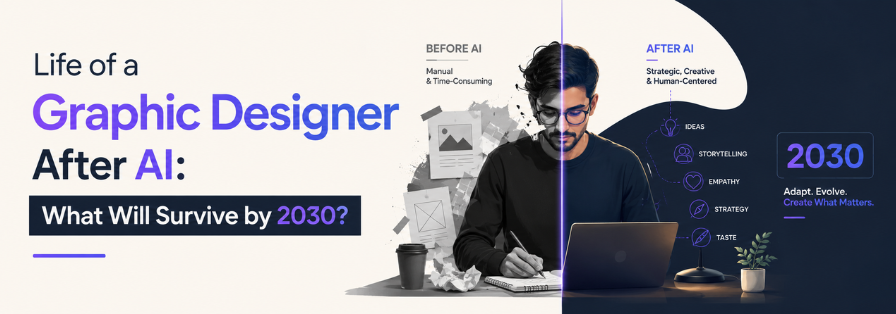


AI can generate visuals in seconds.
But can it replace taste, strategy, storytelling, and human thinking?
A few years ago, most graphic designers were worried about clients asking for “one more revision.”
Now the fear is different.
“Will AI replace graphic designers completely?”
It’s a fair question.
Today, anyone can open an AI tool, type a prompt, and generate logos, packaging concepts, social media posts, ad creatives, illustrations, even full brand identities within minutes.
For many designers, especially beginners, that feels terrifying.
And honestly? Some parts of graphic design are already changing faster than expected.
But after reading hundreds of designer discussions on Reddit, Quora, agency forums, and speaking to people inside the industry, one thing becomes very clear:
AI is not killing graphic design.
It’s changing what clients actually pay designers for.
The future of graphic design may look very different by 2030.
But human creativity is not disappearing anytime soon.
Table of Contents
What the Numbers Actually Say
Not fear-mongering. Just facts.
We went looking for real data, not hot takes. Here’s what we found — pulled from surveys, labour research, and industry reports published in 2024 and 2025.
49%
of 400 graphic professionals across UK, US, France and Germany expect manual graphic production to become obsolete within 5 years
— CHILI Publish Survey, 2024
21%
drop in freelance opportunities already recorded for automation-prone design and writing jobs
— Freelance market research, 2024–25
39%
of designers have taken time off due to work-related stress; same percentage has considered leaving the profession entirely
— CHILI Publish Survey, 2024
47%
estimated probability of automation for graphic design roles over the next 20 years, based on job characteristic analysis
— WillRobotsTakeMyJob, 2025
This data explains why conversations around AI and design suddenly feel much more serious. Designers are not reacting to hype alone. Real shifts are already happening.
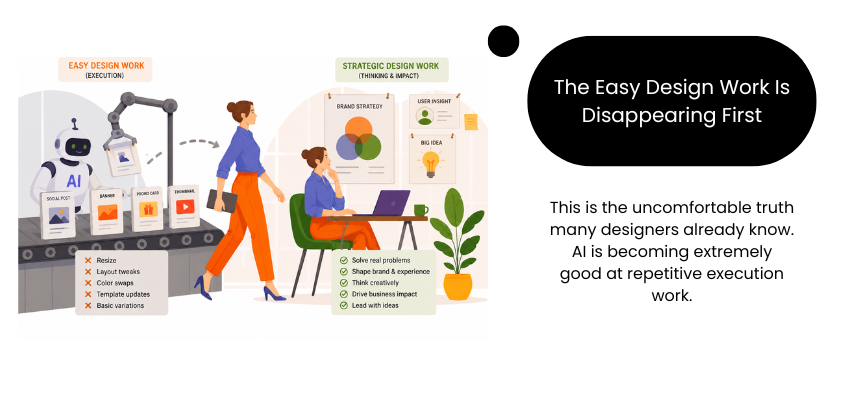
The Easy Design Work Is Disappearing First
This is the uncomfortable truth many designers already know.
AI is becoming extremely good at repetitive execution work.
WHAT’S MOST AT RISK RIGHT NOW
• Social media graphics and templated content
• Simple logo design for small local businesses
• Illustration and image generation on demand
• Resizing and formatting (asset production)
• Basic print ad layouts for small budgets
• Entry-level agency production work
Things like:
- simple social media creatives
- background removal
- basic banner ads
- quick logo drafts
- image resizing
- template-based posts
- basic product mockups
Tasks that used to take two or three hours can now be done in just 10 minutes.
Even clients have started experimenting on their own.
Many small businesses now use:
- Canva AI
- ChatGPT
- Midjourney
- Adobe Firefly
- Looka
- Ideogram
And honestly, for small low-budget work, some of these tools are “good enough.”
That’s exactly what many designers are discussing online right now.
On Reddit, several graphic designers admitted that entry-level production work is becoming harder to charge premium prices for because AI can already handle a large part of it.
Not perfectly.
But fast enough.
And clients love speed.
But Here’s What AI Still Cannot Do Properly
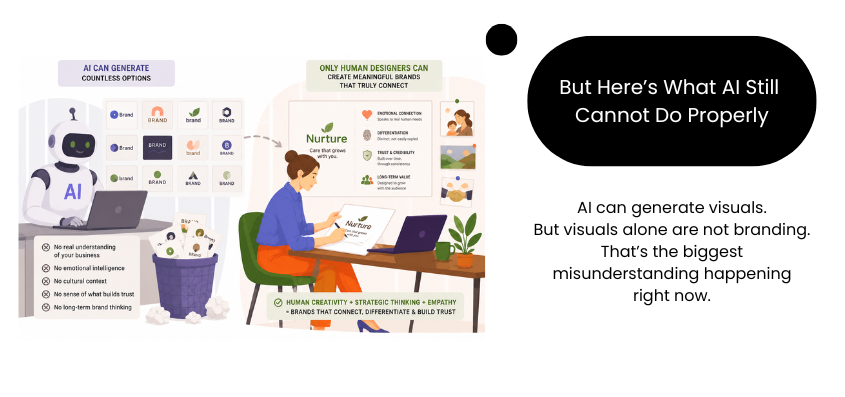
AI can generate visuals.
But visuals alone are not branding.
That’s the biggest misunderstanding happening right now.
A client does not actually need “design files.”
They need:
- differentiation
- market positioning
- emotional connection
- shelf visibility
- trust
- storytelling
- clarity
And this is where experienced graphic designers and design agencies still matter.
Because good design is rarely about decoration.
It’s about decision-making.
A packaging designer working on a retail product is not simply choosing colors.
They are thinking:
- What will stand out in modern retail?
- What will consumers notice in 3 seconds?
- Which visual triggers increase trust?
- How does this product feel premium?
- Will this design work across future SKUs?
AI can generate 100 packaging concepts.
But it still struggles to understand why one brand emotionally connects while another gets ignored.
That part is still deeply human.
Clients Are Already Realising the Difference
Something interesting is happening in the market.
Many businesses first try AI tools themselves.
Then they come back to professional designers.
Why?
Because after the excitement, they hit a wall.
The designs start looking similar.
Brand consistency disappears.
Every creative feels disconnected.
And suddenly they realize:
Generating visuals is easy.
Building a real brand is hard.
This is becoming more common across branding and packaging projects.
Especially for businesses trying to scale.
AI helps create assets faster.
But strategy still needs human thinking.
That’s why many smart design agencies are not fighting AI anymore.
They’re learning how to use it better than everyone else.
The Future May Be Harder for Average Designers
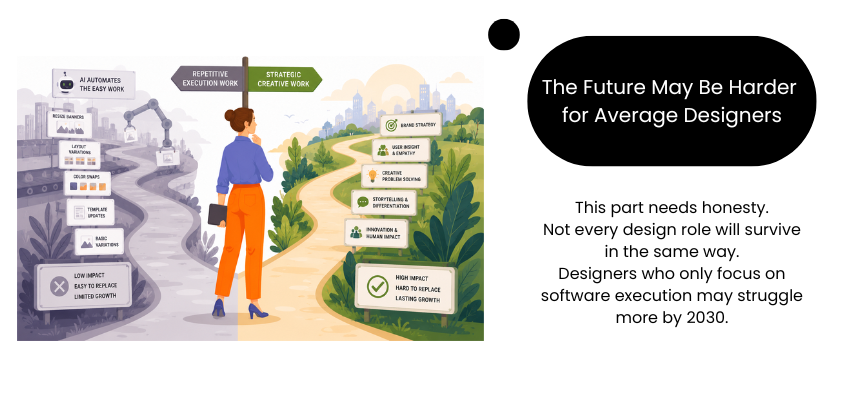
This part needs honesty.
Not every design role will survive in the same way.
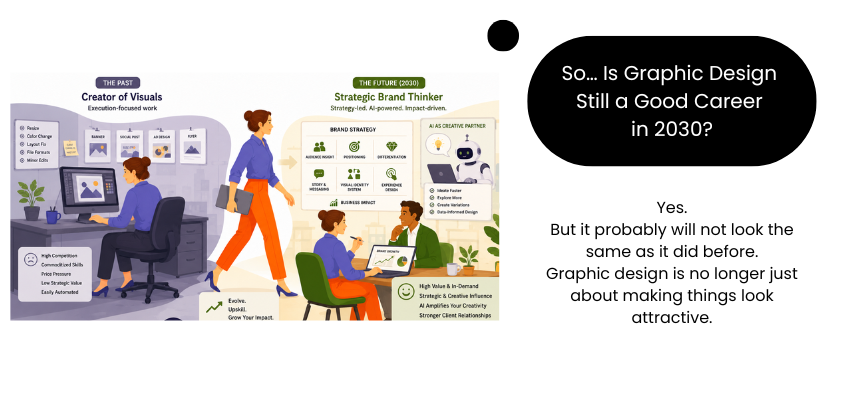
Designers who only focus on software execution may struggle more by 2030.
Especially people depending entirely on:
- template work
- repetitive production tasks
- cheap freelance marketplaces
- generic logo creation
- bulk social media posts
This is because AI is quickly lowering the value of average visual work.
Earlier, knowing Photoshop or Illustrator was enough to stand out.
Now tools are becoming accessible to everyone.
Which means the real value is shifting somewhere else.
Skills Dying vs. Skills Rising
The honest breakdown for working designers
This isn’t about software. A designer who knows Photoshop isn’t safer than one who knows Midjourney. The shift is deeper — it’s about what kind of thinking the profession rewards now.
BECOMING COMMODITISED
- Logo creation for small clients
- Social media template design
- Stock-style illustration
- Asset resizing & formatting
- Basic print layout production
- Image background removal
- Simple icon sets
GROWING IN VALUE
- Brand strategy & positioning
- AI prompt mastery & direction
- UX research & systems thinking
- Creative direction & storytelling
- Cultural & contextual design
- Motion & interactive design
- Handcrafted / tactile aesthetics
Towards:
- creative direction
- brand thinking
- storytelling
- communication
- psychology
- marketing understanding
To put it simply:
The future may reward thinkers more than operators.
Graphic Designers Who Use AI Will Grow Faster
This is probably the biggest shift happening right now.
The strongest designers are not avoiding AI.
They are using it as a creative assistant.
And that changes everything.
A designer who earlier created:
- 3 concepts in a day
Can now explore:
- 20 concepts in the same time
That speed changes ideation completely.
Small design agencies can suddenly compete with much larger teams.
Solo designers can work faster.
Creative exploration becomes cheaper.
Presentation quality improves.
Moodboarding becomes easier.
Research becomes faster.
The workflow changes dramatically.
The designer still matters.
But now their value comes from:
- selecting the right direction
- refining ideas
- adding strategic thinking
- making emotional decisions
- understanding human behavior
AI becomes the tool.
Not the creative brain.
Design Agencies After AI Will Look Very Different
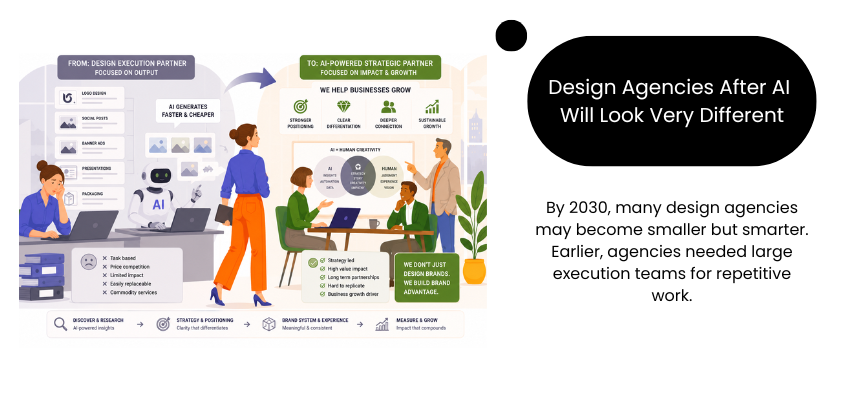
By 2030, many design agencies may become smaller but smarter.
Earlier, agencies needed large execution teams for repetitive work.
Now AI can reduce production time heavily.
That means agencies can spend more time on:
- strategy
- positioning
- research
- creative direction
- brand storytelling
- customer psychology
In many ways, branding agencies might become creative consulting partners rather than just companies that handle execution.
And honestly, this is already happening.
Businesses today don’t just want “good graphics.”
They want:
- market differentiation
- stronger perception
- premium positioning
- retail visibility
- better communication
Design is becoming more business-driven.
And agencies that understand business will survive longer than agencies only selling software skills.
The Biggest Problem Nobody Talks About
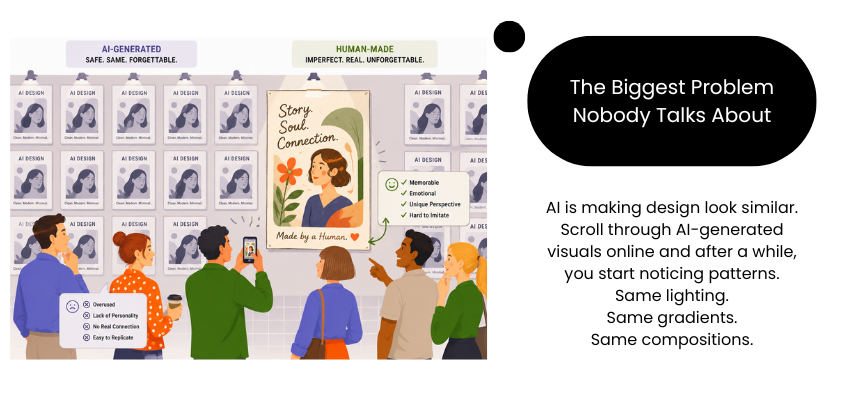
AI is making design look similar.
Scroll through AI-generated visuals online and after a while, you start noticing patterns.
Same lighting.
Same gradients.
Same compositions.
Same polished perfection.
The internet is slowly filling up with visuals that look ‘correct’ but are easy to forget emotionally.
“AI won’t replace all design jobs, but it will certainly shrink the industry by at least a third in the next 10 years.”
— Designer, Reddit/r/GraphicDesigning thread on career viability, 2025
This is why human imperfections might become valuable again.
Brands may move toward:
- handmade textures
- raw visuals
- personality-driven branding
- imperfect typography
- human storytelling
Because people still connect with human emotion.
Not just polished pixels.
Ironically, AI could make originality even more valuable.
So… Is Graphic Design Still a Good Career in 2030?
Yes.
But it probably will not look the same as it did before.
Graphic design is no longer just about making things look attractive.
The industry is evolving into something deeper.
Future graphic designers may need to understand:
- branding
- psychology
- storytelling
- marketing
- business
- AI tools
- consumer behavior
The software itself matters less now.
Thinking matters more.
The designers who survive will likely be the ones who:
- adapt faster
- think strategically
- understand brands deeply
- communicate clearly
- use AI intelligently instead of fearing it
Final Thoughts
AI will absolutely change the life of graphic designers.
Some design jobs may disappear.
Some services may become cheaper.
Some workflows may completely transform.
But creativity itself is not disappearing.
Human taste still matters.
Emotion still matters.
Brand perception still matters.
And businesses will always need people who understand how to connect visually with humans.
The future probably does not belong to designers competing against AI.
It belongs to designers who learn how to direct it.
Author: Anush Malik

Being a strategist’s head and a long term visionary personality aims to achieve excellence in branding, packaging and digital marketing field. My 15 years of design experience and masters degree ais my strength which keeps me motivated and keep me going positively. I have participated in extensive branding design conquests in India, USA, Australia and New Zealand with winning zeal. My objective is to encourage start-ups and hence involves actively in the articles which will act as a productive intake of knowledge for them. Do connect me personally via my LinkedIn and I love to share my expertise with you.